
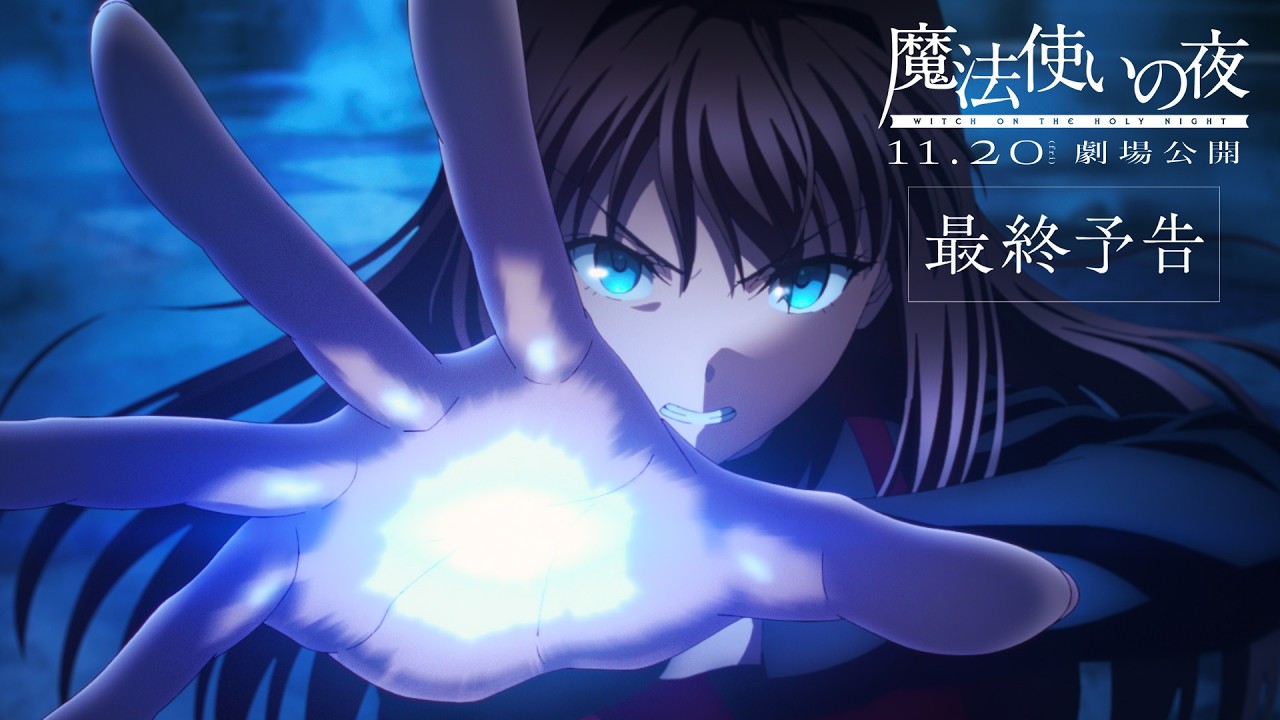
The easiest way to sell Witch on the Holy Night is to show a spell filling an enormous cinema screen. The harder task is making the people beneath it matter. ufotable's adaptation of TYPE-MOON's visual novel opens in Japanese theaters on November 20, 2026, and the production has announced simultaneous IMAX screenings. The final trailer promises the kind of elaborate effects that studio followers expect. The underlying story, however, begins with a much smaller disturbance: a young man entering the lives of two women who are trying to keep their magic hidden.
The project has been anticipated since its original anime announcement, and the marketing now has a concrete date, a creative team, a theme song and new theatrical artwork. That makes it news, but it also raises an ordinary question about adaptations: how do you turn a visual novel built around reading, atmosphere and quiet conversation into a film with a fixed running time?
Before the spectacle, there is a house on a hill
The story takes place around Misaki near the end of the 1980s. Aoko Aozaki is an apprentice magician learning from Alice Kuonji, who lives with her in a mysterious mansion. Soujuurou Shizuki enters their orbit as a boy who knows little about the strange world around him. The relationship is not constructed like a conventional action franchise in which a newcomer arrives and immediately starts defeating enemies. Its early tension comes from how differently the three people see the same place.
The visual novel originally arrived in Japan in 2012 and later received an English release. It is associated with writer Kinoko Nasu and the TYPE-MOON universe, but audiences do not need to complete every Fate game to understand its premise. What they do need is patience for a story whose sense of wonder often comes from a quiet room, a night street or a conversation in which someone is withholding an important piece of information.
ufotable is a sensible choice for the film's supernatural set pieces. Its work across Demon Slayer and Fate adaptations has made moving light, depth and complicated effects a part of its public identity. But animated spectacle is not automatically a faithful adaptation of a dense text. The more carefully the original uses silence, the easier it is for a fast movie to flatten the characters into their most obvious traits.
What the new trailer and IMAX announcement tell us
The studio released a final trailer on September 30, previewing the theme song “Yoru to Ao” by supercell, written and composed by ryo with vocals by Nagi Yanagi. The song ties into a longer TYPE-MOON musical history, but its more immediate job is to carry the mood of the film. The promotional campaign has also shown battle-focused character visuals for Aoko, Alice and Soujuurou.
On October 29, the official website confirmed IMAX screenings beginning alongside the standard Japanese theatrical release. IMAX is a presentation format, not a guarantee about animation frame count, story length or a special alternate cut. It can make a carefully composed cityscape look wonderful. It cannot repair a film that races past its relationships to reach the next explosion.

The creative credits offer more concrete clues. Masaru Takeuchi directs, with Moe Tsuzuki handling character design and Masato Nagamori as chief animation supervisor. The film has a defined production structure rather than an anonymous promise that the famous studio name will solve everything. Audiences can judge the result only after seeing the complete work.
International release is not the Japanese premiere
The Japanese release is set for Friday, November 20. Crunchyroll has announced international theatrical distribution beginning in January 2027, including North American screenings on January 29. That does not establish an exact India date or cinema list. Until a local distributor or theatrical partner publishes bookings, a worldwide plan should not be rewritten as an India opening on the same day as Japan.
A small cross-promotional campaign with Puella Magi Madoka Magica: Walpurgisnacht Rising gave this launch an unusual extra spotlight. The two films received collaboration art from the studios behind them, SHAFT and ufotable. It is an attractive way to place two magical stories side by side, but it does not make the films connected narratives or part of a shared fictional universe.
For viewers who know Witch on the Holy Night only through short clips, the expectation might be an uninterrupted series of fights. That would sell this particular work short. The magical system is important, but so is the ordinary unease of three people learning whether they can live together without destroying the distance that keeps them safe.
There is a reason the original story's quieter moments have survived more than a decade of discussion. Its atmosphere is not decoration around a plot; it is the way the plot becomes believable. When the film reaches the loudest possible screen in November, its greatest achievement would be to preserve the feeling of standing in a silent room just before someone says something they cannot take back.