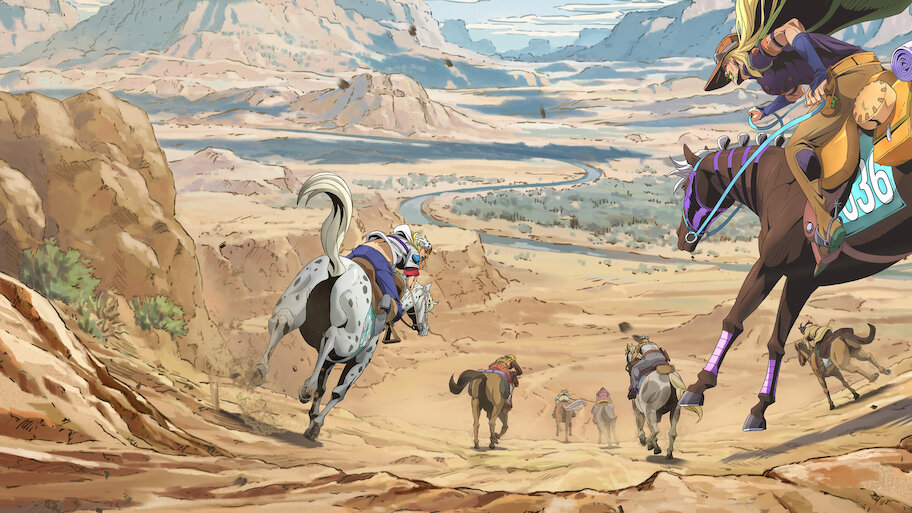
Steel Ball Run has a rare advantage over most long-awaited anime adaptations: its central premise already sounds like an episode you would want to watch. A former champion jockey who can no longer walk joins a race across 1890s America, guided by a mysterious competitor carrying steel balls. There are horses, money, strange abilities and people with motives they would rather keep quiet. That is plenty for a season. Hirohiko Araki somehow makes it the starting line.
Netflix began releasing the second and third stages of JoJo's Bizarre Adventure: Steel Ball Run on September 25, 2026. The important detail is the rhythm. These stages comprise 11 episodes released weekly on Fridays, according to Netflix's official Tudum schedule. After years of fans waiting for an adaptation, the platform has given them something many anime viewers missed during the giant-batch streaming era: a week to argue about what just happened.
Steel Ball Run's Netflix schedule, without the confusion
The first stage premiered earlier in March as a 47-minute episode. The second stage began on September 25, and the second and third together are being released weekly. Netflix describes the current run as a split-cour release; it has not promised that the remaining six stages of the race will follow the same calendar indefinitely.
That distinction is important when you see a confident-looking release chart online. Netflix has confirmed the 11-episode run and Friday cadence. It has not announced a complete broadcast schedule covering every later part of the story. The series is distributed globally on Netflix, so Indian subscribers can use their own Netflix listing to check the latest available episode and dub options.

Johnny Joestar's story is not just about winning a race
Johnny was once a successful jockey. Now he uses a wheelchair, and his decision to join the Steel Ball Run begins with an encounter that suggests something beyond conventional medicine or athletic training might be possible. Gyro Zeppeli, who fights with spinning steel balls and possesses secrets of his own, becomes his unlikely travelling partner.
It would be easy to sell the series purely as an action spectacle. That would miss why its relationship works. Johnny is not a cheerful hero who has already accepted everything that happened to him. He can be proud, defensive and desperate. Gyro knows more than he admits, yet he is hardly the calm adult supervising Johnny's adventure. Their friendship develops through risk, disagreements and hard choices. The best adaptation will make room for those uncomfortable moments instead of hurrying to the next Stand battle.
A western journey also gives the story a physical texture that many JoJo settings lack. Distance matters. Weather matters. A horse getting tired is not an abstract inconvenience you can solve with a stronger punch. The race is a competition, but it also forces characters to live alongside people they may not fully trust. That is why the weekly release helps. One difficult crossing has time to feel difficult before the next one begins.
What is the Devil's Palm?
The second stage draws Johnny and Gyro toward the Devil's Palm, an ominous area in the desert connected to extraordinary incidents. Netflix's official trailer makes it clear that the race is becoming something stranger than an endurance contest. The exact experience is better discovered through the episode than through an exhaustive list of powers and surprises.
For new viewers, the useful point is that JoJo changes its rules with each major part. Steel Ball Run starts a distinct continuity, with its own setting and character relationships. Familiar names and themes may carry extra meaning for longtime fans, but knowing every earlier Joestar's history is not a condition for enjoying this story.

A weekly adaptation has to earn its pacing
There is an argument against weekly viewing: a tense race can feel less immediate when you have to wait for the next leg. But the alternative has its own weakness. Release an elaborate story in one huge batch and conversations collapse into a race to the ending. Fans who have not watched everything start avoiding social media; the details that make a good episode special vanish beneath the final twist.
With Steel Ball Run, the smaller chapters matter. Gyro's choices, Johnny's unreliable instincts and the dangerous people circling the prize should leave viewers with something specific to discuss. A weekly format creates that opportunity. It cannot manufacture good pacing, and anime production is still capable of awkward cliffhangers and uneven episodes, but it gives the work some breathing room.
If you are waiting until every episode exists before starting, that is a perfectly reasonable way to watch. If you prefer experiencing a show with its audience, Fridays have become part of this story. Either way, the important thing is not the size of the Netflix drop. It is that Johnny and Gyro finally have room to be characters rather than merely iconic images from manga panels.