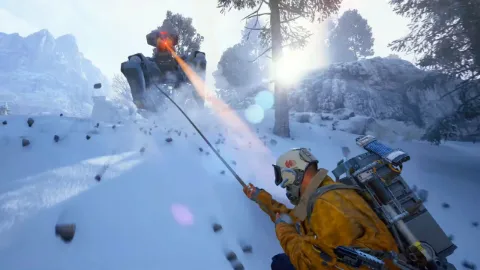

One of the more consequential PS5 announcements this week is not a new game. It is a new rendering option arriving in games people already own. Sony has confirmed that its AI-guided upscaling technology, Quick Spectral Super Resolution or QSSR, is being added to Marvel's Spider-Man 2 and is planned for several other titles, including ARC Raiders, The Finals and No Man's Sky. The pitch is clearer images and more stable detail without needing to buy a new console.
That last point is important. Sony's earlier PlayStation Spectral Super Resolution technology, PSSR, is closely associated with PS5 Pro. QSSR is described as technology for the standard PS5, developed on the same foundation and using a compatible integration approach. It is easy to confuse the two names, and some headlines have done little to explain the distinction. The new announcement is specifically interesting because it extends the conversation to the console already sitting in millions of living rooms.
The six games Sony named
Sony's November 13 announcement identifies Marvel's Spider-Man 2, Control Resonant, The Finals, ARC Raiders, No Man's Sky and Hell Let Loose: Vietnam. They do not all have the same release status. Insomniac says the Spider-Man 2 update is live now, with QSSR improving sharpness and image stability in both Fidelity and Performance modes. Remedy says its Control Resonant update is coming in December. Embark Studios says updates are coming to ARC Raiders and The Finals. Hello Games points to an update for No Man's Sky in the next few weeks, and Expression Games describes QSSR as an upcoming improvement for Hell Let Loose: Vietnam.
Those distinctions matter if you are deciding whether to reinstall a game tonight. One title being updated does not mean every title in a promotional list has already received the feature. Check each game's own update notes before hunting for a setting that may not exist yet.
What upscaling actually changes
Modern games often render a frame internally at a lower resolution, then use an upscaling system to build a sharper-looking final image. That helps balance visual quality against the GPU workload. The challenge is preserving fine detail and avoiding shimmering, jagged edges or unstable patterns during movement. AI-assisted systems attempt to reconstruct more convincing detail from the information available to them.
Sony says QSSR can provide cleaner edges, more stable images and better sharpness than traditional upscalers. That is a product claim supported by developer statements, not a universal promise of higher frame rates in every game. A title might use the additional headroom for clarity, performance or a particular combination. The improvement you notice will depend on the game, display and selected graphics mode.
Why Spider-Man 2 is the practical test
Spider-Man 2 is particularly suited to showing the difference because its camera moves rapidly through a dense city. Fine building lines, distant windows, foliage and fast traversal can expose weaknesses in image reconstruction. Insomniac's claim that QSSR improves both Fidelity and Performance modes makes it a useful case study. Players should compare the same location and camera movements before and after the update instead of relying on static menu screenshots.
There is an important distinction between increased image clarity and a fundamentally redesigned graphical presentation. This update does not add a new open world, higher asset-quality pack or a different game. It aims to reconstruct the existing image more effectively.
What ARC Raiders and The Finals stand to gain
Embark's two games use large, active environments where seeing movement against complex backgrounds matters. The studio says QSSR should bring greater sharpness and environmental clarity. That could make foliage, structures and distant silhouettes easier to read, but players should not interpret that as a promise of competitive advantage. Whether an individual player perceives a difference will need real gameplay comparisons.
For No Man's Sky, the benefit is different. Its sprawling landscapes, dense structures and enormous range of scales create persistent challenges for image stability. Hello Games says a forthcoming update will aim for sharper details while maintaining the best practical frame rate. Control Resonant and Hell Let Loose: Vietnam have their own rendering challenges, with Remedy emphasising fine detail and Expression Games pointing to the visual complexity of dense jungle scenes.
Do you need a PS5 Pro?
Not for the QSSR improvements Sony is announcing here. The PlayStation Blog explicitly frames QSSR as an option for the PS5 players already own, while explaining the technology's relationship to PSSR on PS5 Pro. The key caveat is game support. This is not a switch you can enable globally to force every title to use the same system.
It also should not be confused with the console's output resolution in Settings. Choosing a 4K display mode is not the same as the game rendering through QSSR. The integration happens inside compatible game software.
This is a significant kind of platform improvement precisely because it happens late in a console's life without changing its physical hardware. The sensible next step is to compare real footage as the announced updates arrive. For now, the confirmed news is which games are participating and which developers have committed to shipping support, not that every PS5 game suddenly looks like a Pro version.