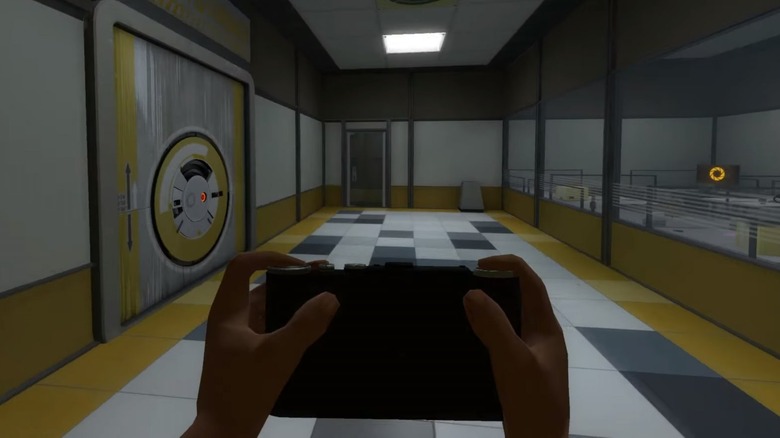
A lost chapter of Portal's history has become playable—though not through Valve. F-Stop, an abandoned puzzle project once considered as a prequel to the original game, has been reconstructed by members of the game's preservation community using material from several leaks. The result offers a remarkably complete look at an experiment that helped shape Valve's thinking before Portal 2.
That does not make F-Stop an official release, a newly announced sequel or a commercial game approved for distribution. The story matters because a concept known mostly through interviews, development history and a few demonstrations can now be examined as an interactive design.
What was F-Stop?
F-Stop grew out of Valve's 2007 Directed Design Experiments, when developers split into smaller groups to test potential games. One team pursued a camera-based puzzle mechanic instead of the portal gun familiar from Portal. The proposed device played with photography, objects and scale. It was set within the Aperture Science world and explored the possibility of a prequel without simply reproducing the first game's central tool.
The project was ultimately abandoned. Elements of its world-building and ideas were later repurposed or revisited during Portal 2's development. That route from prototype to cancellation explains why F-Stop has remained such a persistent subject for fans of game design: it belongs to one of Valve's most celebrated series, but follows a different mechanical idea.
What leaked in 2026?
Reporting by Kotaku on November 1 says community members combined three sets of materials. A large Steam depot leak in August reportedly contained most of the assets, while later leaks supplied source code and map-source data. The Valve Cut Content community then used those pieces to rebuild a playable version.
The report describes the result as close to complete but still missing some assets and dialogue. That is the assessment of people involved with the reconstruction, not a quality certificate issued by Valve. It may play like a late-stage experiment rather than a polished product, and neither completeness nor provenance should be treated as settled without independent technical review.
The article should not provide links to leaked proprietary code, game archives or unauthorised download mirrors. Coverage of the game's design and history is different from redistributing the material through which that history resurfaced.
The important mechanic is not a portal
What made Portal special was a rule the player could understand immediately and then stretch into increasingly complex puzzles. F-Stop tested whether a camera could offer the same elegant relationship between a small action and an enormous environmental consequence. It is a useful reminder that Portal's identity was not limited to orange and blue holes in a wall.
The camera mechanic has previously been discussed in documentaries about abandoned Valve experiments. The reconstruction may allow players to compare those descriptions with how the prototype actually structured rooms, objects and puzzle progression. A mechanic can seem brilliant in isolation while struggling to support the length and variety of a complete game. Early playtests reportedly contributed to Valve's decision not to continue.
Why preservation is not the same as a commercial revival
Fans often imagine that a leaked prototype could be polished and sold once it has been found. That is rarely straightforward. The code and artwork remain subject to intellectual-property and distribution rules. Original developers may not be involved, and dependencies can be hard to maintain. What is valuable as a research object might be unsuitable as a retail product.
There is still real cultural value in learning how a celebrated studio arrived at its final ideas. Games are frequently lost not because nobody cared about them but because unfinished work is discarded, archived in private or trapped on inaccessible systems. F-Stop gives historians and designers an unusually clear example of the road not taken.
What this does not confirm
Valve has not announced Portal 3 or a re-release of F-Stop. Nor does the reconstruction show that the concept was due to ship before it was cancelled. Players interested in the original game should continue using legitimate store releases, while following coverage of F-Stop as a preservation and design-history story.
The story is not that Valve has finally launched a new Portal. It is that a community has made a discarded experiment visible again, complete enough to prompt the question that first ended it: could a different camera have carried an entire Aperture Science adventure?