

Four million new CPU cores would be a remarkable headline for a cloud company. Coming from GitHub, they are a clue about the kind of software-development company it is becoming. At GitHub Universe 2026, the Microsoft-owned platform said it had added four million CPU cores, 160 petabytes of high-speed storage and 50 terabits per second of network capacity during the year. The statement is about infrastructure built, not the amount of capacity currently occupied, and it does not mean every added processor runs an AI agent.
The timing, however, is hard to miss. GitHub’s latest Octoverse analysis describes an ecosystem in which automated coding agents are moving from demonstration videos into day-to-day repository activity. The infrastructure announcement asks a question developers should take seriously: if software can be drafted, tested and submitted faster than a human can read it, who is going to keep the work reliable?
The numbers describe two different things
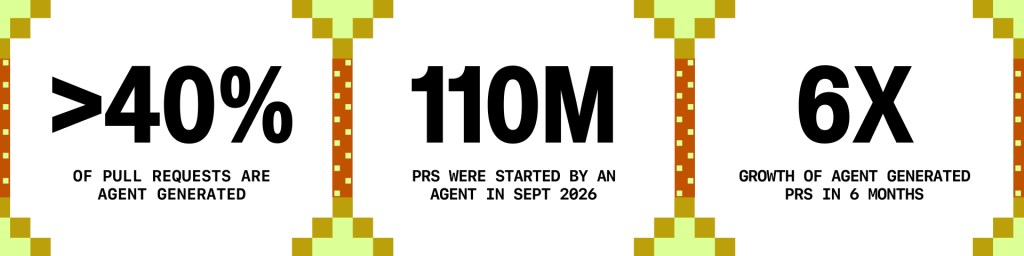
GitHub reported 17.9 billion code pushes across the previous twelve months. Its Octoverse reporting also said agent-initiated pull requests accounted for more than 40 percent of a measured slice of activity by September, compared with roughly 17 percent in March. Those figures have different definitions and denominators. A push is not a pull request, and an agent-started request is not proof that a model wrote every line, passed review or shipped successful software.

The meaningful shift is in the shape of work. A human developer used to carry an idea through repeated local edits before asking teammates to review a change. A coding agent can now open a branch, propose multiple files and submit work while its operator handles another issue. That is useful for routine migrations or repetitive tests. It can also produce a queue of plausible changes that require painstaking review.
More code can make less progress
Imagine a five-person game studio preparing a multiplayer patch. An agent proposes ten fixes for matchmaking, telemetry and item balancing before lunch. The studio has not gained ten tested fixes. It has ten hypotheses with code attached. Someone still has to reproduce the bug, inspect edge cases, run compatibility checks and decide whether the changes damage the experience for players.
For open-source maintainers, the problem is sharper. Their projects may receive agent-generated patches from people who do not understand the repository or intend to support the changes later. A well-written explanation from an AI model can resemble expertise. It cannot substitute for familiarity with the system’s failure history, threat model or users.
GitHub has a financial reason to accommodate this traffic. More branches, automated builds, artifact storage and repeated testing can increase demand for compute. Yet the reported infrastructure expansion should not be read as a neat causal equation in which agents alone explain four million cores. The platform also serves conventional CI, large enterprises and human-authored open-source projects. No public breakdown proves that agents are responsible for each additional unit of capacity.
The bottleneck is changing position
The old complaint about programming was that writing boilerplate took too long. The newer complaint is that generated changes can arrive faster than maintainers can establish trust. Review queues, security scanning, reproducible tests, provenance and deployment permissions become more valuable when creating a patch is comparatively cheap.
There is also a hidden cost in agent activity. Tests consume infrastructure, and reviewers spend attention. A team that measures only pull requests merged may reward volume over value. Better measures include time to fix a customer-visible bug, regressions after release, review turnaround and the amount of work that survives three months without being rewritten.
This is why GitHub’s infrastructure announcement belongs beside Octoverse rather than beneath it as a footnote. One describes physical capacity. The other describes changing behavior on top of that capacity. Neither tells us how much high-quality software the industry ultimately gained, and neither establishes that coding as a profession is disappearing.
What a small team should do now
Teams experimenting with agents should start with narrow permissions and clear review ownership. Let the tool open a draft pull request, but keep release keys, production database changes and destructive operations behind human approval. Demand executable tests and make a human confirm the relevant behavior. An agent that can describe its approach is useful; an agent that can show a reproducible failing test and a passing fix is more useful.
It also helps to track which work an agent initiated. The purpose is not to stigmatize AI-assisted code. It is to make unexpected regressions traceable and compare outcomes honestly. If teams cannot say whether automated patches are improving product quality, more automation is only another expense.
GitHub’s October announcements suggest the next competition in developer tools will not be decided by who produces the most code in a minute. The harder contest is over dependable workflows: turning fast drafts into changes another developer can understand, verify and safely ship. Four million cores are impressive. They will matter most if the people reviewing what those cores help create can still keep up.