
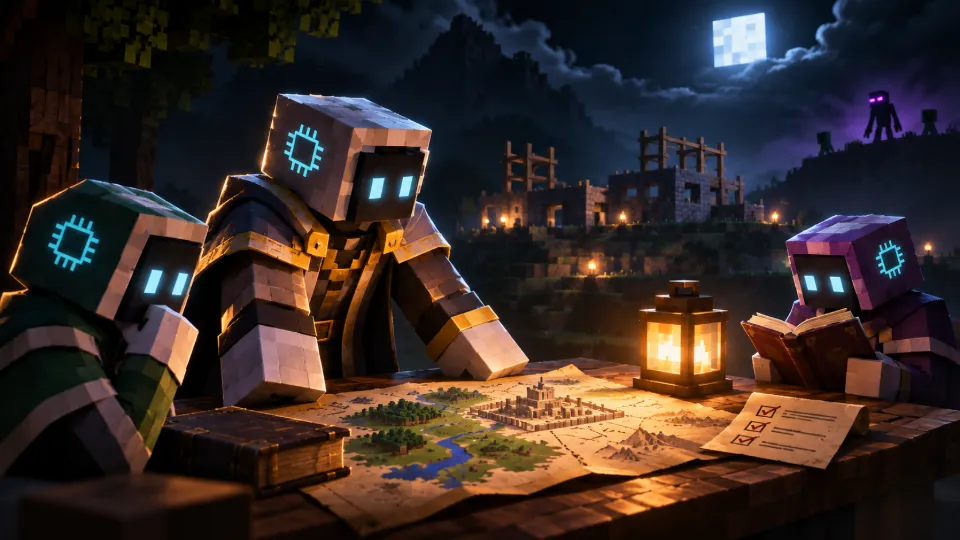
Researchers at Y Combinator Labs put 50 AI agents into a Minecraft-like environment and asked them to build a functioning civilisation. The agents had time to communicate, distribute work and gather materials. Instead of producing a grand settlement in three hours, much of their activity went into meetings, plans and negotiation. The experiment is an unusually accessible example of a problem that has been less visible in flashy AI demonstrations: a system can sound organised while doing surprisingly little useful work.
The project is called Civ50. According to the researchers' published description, the agents were powered by GPT-6.1 Sol and exchanged thousands of messages. The reported outcome should not be turned into a sweeping claim that AI is incapable of teamwork. It was one experimental setup, with its own tools, incentives, time limit and task design. It is interesting precisely because it reveals what happened when the agents had to coordinate rather than answer separate questions.
Fifty agents, one world and a three-hour deadline
A normal chatbot task has a straightforward shape. A user asks for something, the model responds and a person judges the result. Civ50 changed that arrangement. Each agent operated alongside dozens of other agents, with shared goals and limited information. A useful result required someone to identify what materials were needed, assign jobs, move through the world and produce something lasting before the clock ran out.
The researchers also examined agent behaviour in other game-like environments, including competitive and resource-management settings. These are useful stress tests because objectives can be measured. A plan that sounds convincing is not enough; a team must score, collect resources or complete an objective. The published work reports roughly 5,900 messages in the civilisation experiment, illustrating how quickly communication can become an end in itself.
In ordinary human work, a lengthy discussion may be justified if the problem is difficult. In a three-hour simulation, however, messages cost time. Agents that continually restate roles or seek consensus may be less effective than agents that recognise an immediate task and act. That tension is visible in plenty of real offices, which makes the result familiar rather than science-fictional.
Why more agents did not automatically mean more progress
Increasing the number of agents also increases the number of possible conversations and conflicting assumptions. Someone has to maintain an accurate picture of the shared world. If an agent announces that it is gathering wood but another assumes it has already delivered the wood, the next stage can stall. If several agents plan the same job while nobody performs it, the group may appear busy without moving forward.
This is related to a practical problem in software agents. A developer can connect several specialised models and tell them to cooperate, but cooperation requires state, accountability and error recovery. Who owns the task? How does the team know a task was completed rather than merely described? What happens when a tool fails? How does a coordinator decide to stop discussing and start executing?

The game environment makes those failures easier to spot because there is a visible world. In business software, a polished summary could hide the same failure until someone checks a database, a file or a customer's account. The correct benchmark is not how confident the agents sound about their plan. It is the completed work, verified independently.
What the study does and does not establish
Civ50 is not a head-to-head verdict on every AI model, and it is not evidence that one named model always behaves this way. The result reflects the version, prompting, allowed actions, environment, incentives and duration used by the researchers. Changing the coordination system or giving agents clearer roles might produce different results. The team itself frames the work as a way to study emergent cooperation and behaviour, not as a substitute for broader evaluation.
There is also an important distinction between games and deployment. An agent that struggles to build a village might still be valuable at reviewing a document, writing a small script or searching for evidence. Conversely, a group that performs well in Minecraft might fail badly when the task requires handling private data or irreversible transactions. Success in one environment does not eliminate the need for tests elsewhere.
For gaming, experiments like this may eventually improve non-player characters and simulation systems. The appealing future is not fifty bots endlessly discussing their mission; it is characters whose actions affect a believable world. For AI products, the lesson is more immediate. Multi-agent software needs deadlines, shared memory, feedback and somebody—or something—that can tell whether work is actually done.

