
For most of 2026, South Asia’s international VALORANT hopes came down to one team. Win the regional race, reach a Pacific Last Chance Qualifier, and try to take one of the biggest steps in the game. If that team fell short, there was no second South Asian representative waiting in the same bracket.
Riot Games has now changed that picture for 2027. South Asia will be allowed two teams in the Pacific Kickoff Last Chance Qualifier, and two again in the Last Chance Qualifier for each of the two Pacific Cups. For Indian fans, the headline is exciting. More teams can reach the international qualifying stage. But getting into that stage and getting into VCT Pacific are still two very different achievements.
This is what the new announcement actually gives India, what it does not give, and why the lessons from S8UL and No Salary Peek in 2026 make the change more important than the slot count alone.
Key facts: VCSA 2026 vs the new 2027 pathway
- 2026 SOUTH ASIA →
- One representative entered the four-team Pacific LCQ. That LCQ awarded one place at VCT Pacific Stage 2 Playoffs. South Asia had no guaranteed direct Stage 2 Playoffs place.
- 2027 KICKOFF →
- Two South Asian teams enter a four-team Kickoff LCQ. Its single winner enters the 12-team Kickoff in Bangkok.
- 2027 CUP 1 AND CUP 2 →
- Two South Asian teams can enter the eight-team LCQ for each Cup. Each LCQ offers one Cup place, not two.
- DIRECT MAIN-EVENT SLOTS →
- 2026- none reserved for South Asia at Stage 2 Playoffs. 2027-none reserved for South Asia at Kickoff or either Cup. The teams must first win an LCQ.
- REPEAT OPPORTUNITIES →
- 2026- one main Stage 2 qualification route for South Asia. 2027- Kickoff plus two separate Cup qualification cycles, subject to each cycle’s regional results and eligibility.
- FINANCIAL SUPPORT →
- 2026- US$75,000 for eligible Challengers teams that reached Stage 2 Playoffs. 2027- US$100,000 per Kickoff or Cup qualification for eligible open teams. Merely playing an LCQ does not earn the payment.
- NEXT STEP →
- 2027 South Asia open qualifiers are expected to begin in November 2026. Registration dates, brackets and local rules are still to be announced.
Here is the simplest way to read those numbers: South Asia goes from one contender at a single decisive 2026 Pacific LCQ to two contenders in several 2027 LCQ windows. It does not go from one guaranteed VCT Pacific slot to two. In either year, an international LCQ win is required before a South Asian team can enter the main Pacific competition.
What South Asia had in 2026, and why one slot felt unforgiving
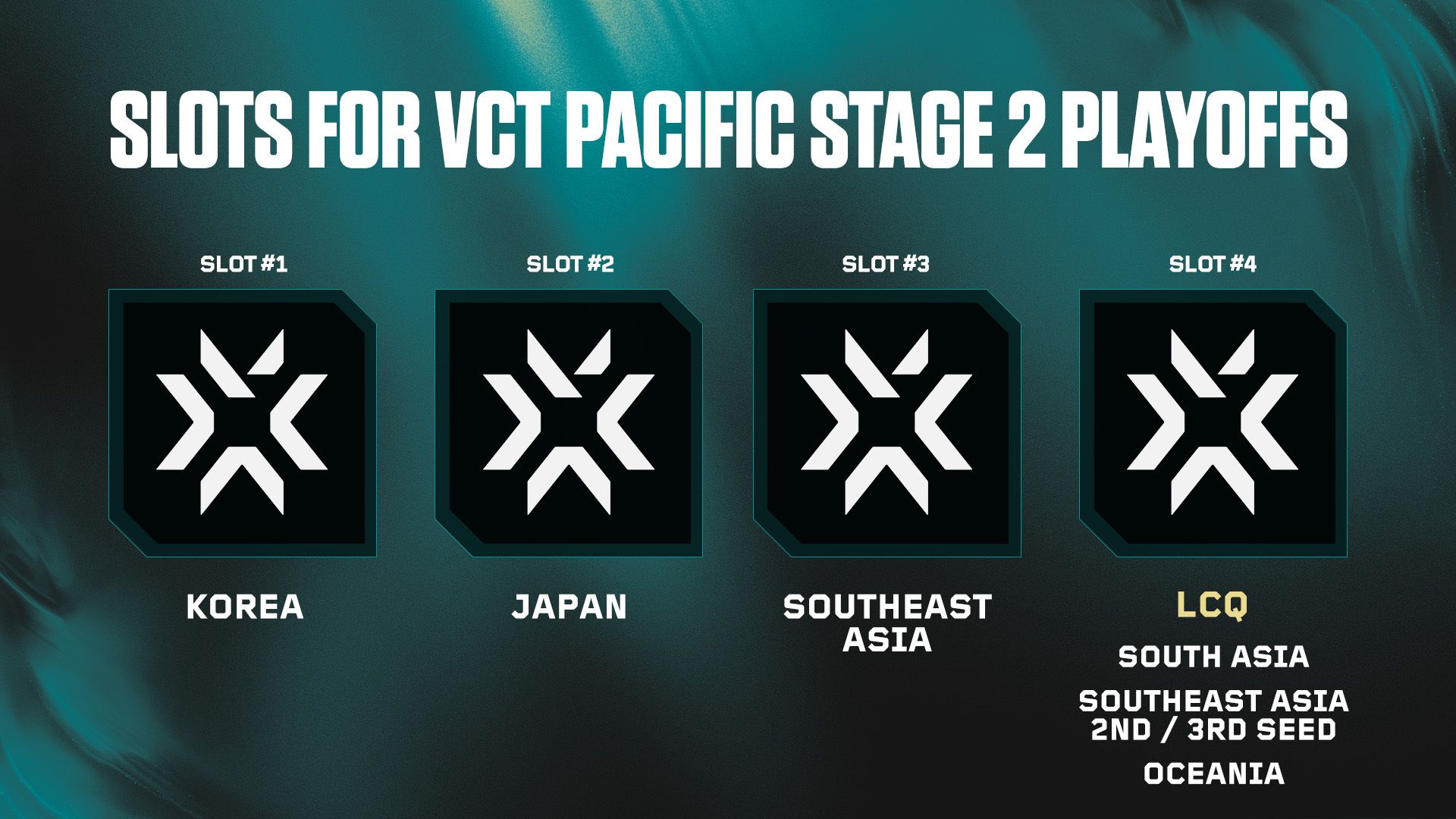
Riot’s 2026 Challengers Path to Champions removed the older Ascension ladder as the immediate route to the top level. Four Challengers teams could join the Pacific Stage 2 Playoffs. South Korea, Japan and Southeast Asia each had a direct representative. The fourth place was decided by a four-team LCQ: one South Asian side, one Oceania side and the second- and third-place Southeast Asian teams.
South Asia could get into that LCQ by winning its regional circuit. But even the South Asian champion still had to beat teams from other regions to reach the Pacific Stage 2 Playoffs. A domestic title was a qualification achievement, not a ticket to Champions. The Pacific Playoffs would be another fight entirely.
The local circuit was not a small online cup, either. NODWIN’s 2026 VCSA featured open qualifiers, a Split 1 league, promotion and relegation, a second split and playoffs. Eight teams contested Split 2. That long season built towards one regional representative in the Pacific LCQ, which put enormous weight on a single grand final.
2 slots for SA wow, thank you Riot
It will be our fault if we don't use these opportunities for good
S8UL and No Salary Peek showed exactly why a second place matters
S8UL Esports were one of the region’s best stories in 2026. They won Split 1 after a five-map final against Revenant XSpark. SkRossi and the team then finished top of Split 2’s league phase with six wins and one loss. On form, they had a convincing claim to be the region’s leading side.
No Salary Peek took a less direct road. They finished fifth in the Split 2 league phase with four wins and three losses. Once the playoffs began, however, they survived the lower bracket, beat Revenant XSpark and faced S8UL in the grand final on June 28. S8UL led the series 2–1. No Salary Peek won the next two maps, completed a 3–2 comeback and became South Asia’s sole representative in the 2026 Pacific LCQ.

No Salary Peek earned their shot fairly. They did not, however, make it into Pacific Stage 2. At the July LCQ they lost 1–2 to Team 555, then 0–2 to Yi-Jing, and finished #4th. The result is a useful reminder of how high the jump was from South Asian domestic competition to the next level.
Under the newly announced 2027 arrangement, a comparable regional playoff would send 2 South Asian lineups into its LCQ instead of 1. That would not guarantee either team advances. It would, though, mean a strong runner-up gets to test itself against the wider Pacific field instead of watching the entire international opportunity vanish after a domestic final.
2027 Kickoff: two South Asian teams start one step below Bangkok
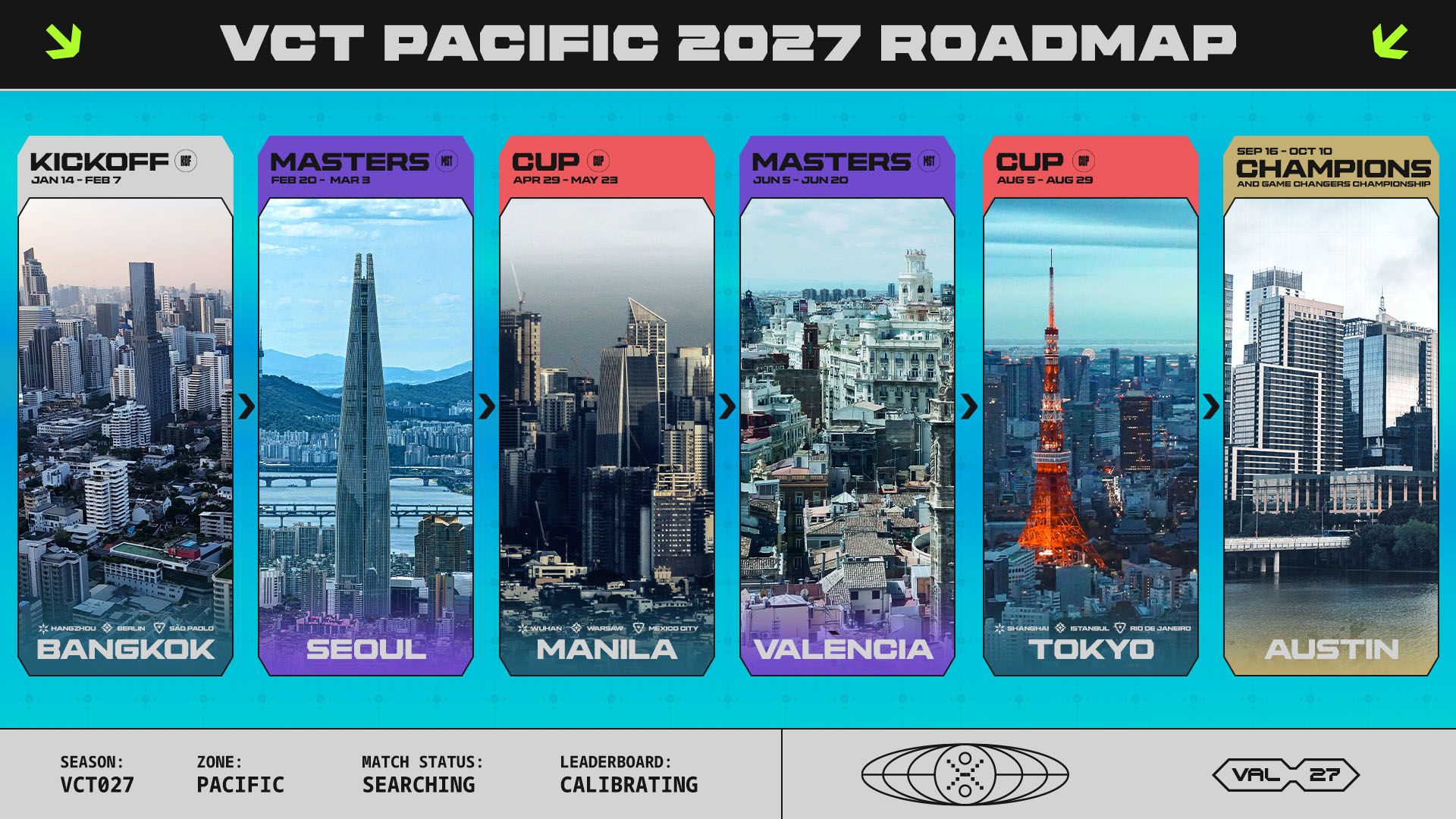
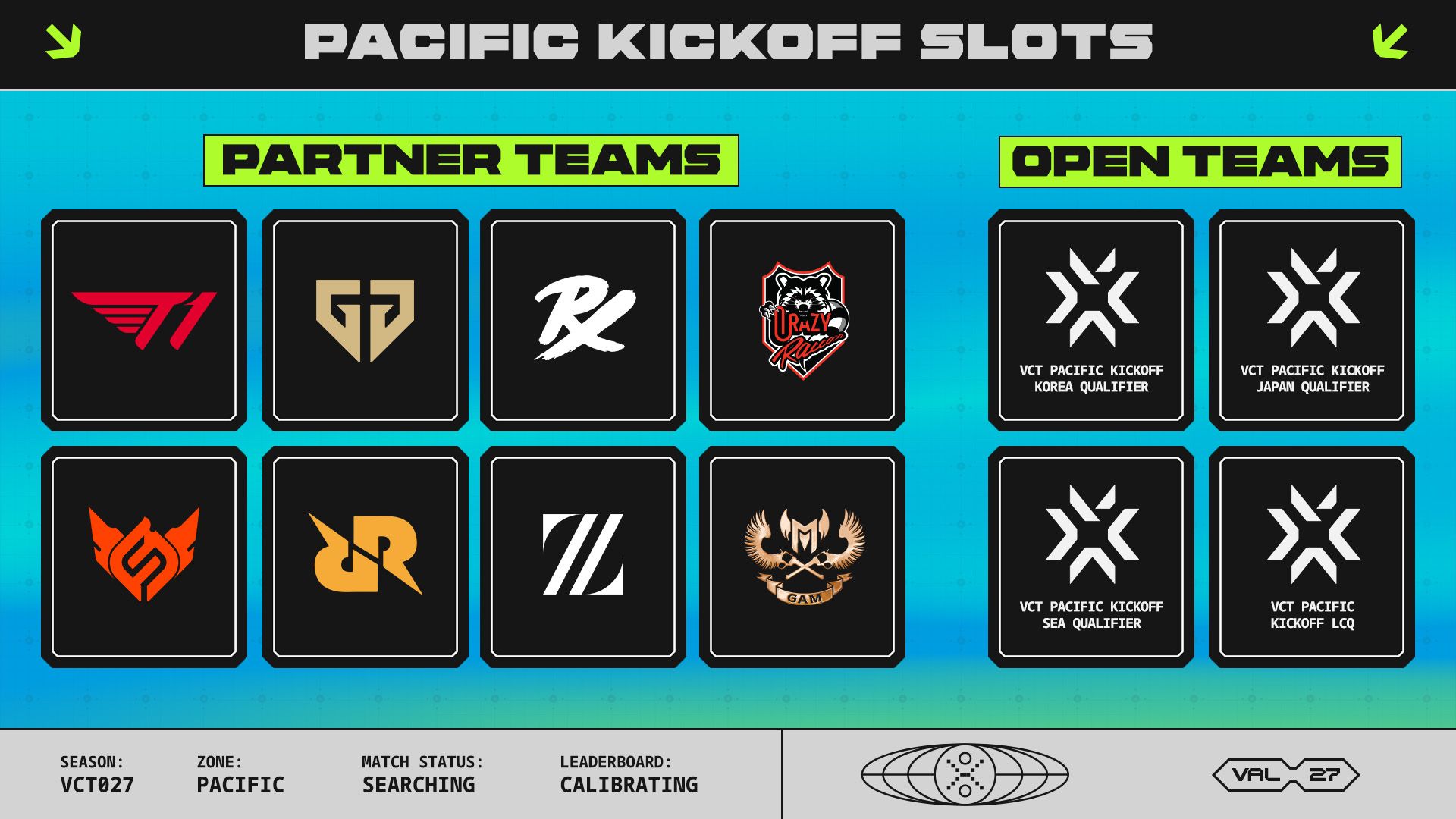
The 2027 VCT Pacific season begins with Kickoff in Bangkok, running January 14 to February 7. The event has 12 teams: 8 partnered organisations and 4 teams that qualify through open routes. Korea, Japan and Southeast Asia each receive one of those open places. The fourth comes from the Kickoff LCQ.
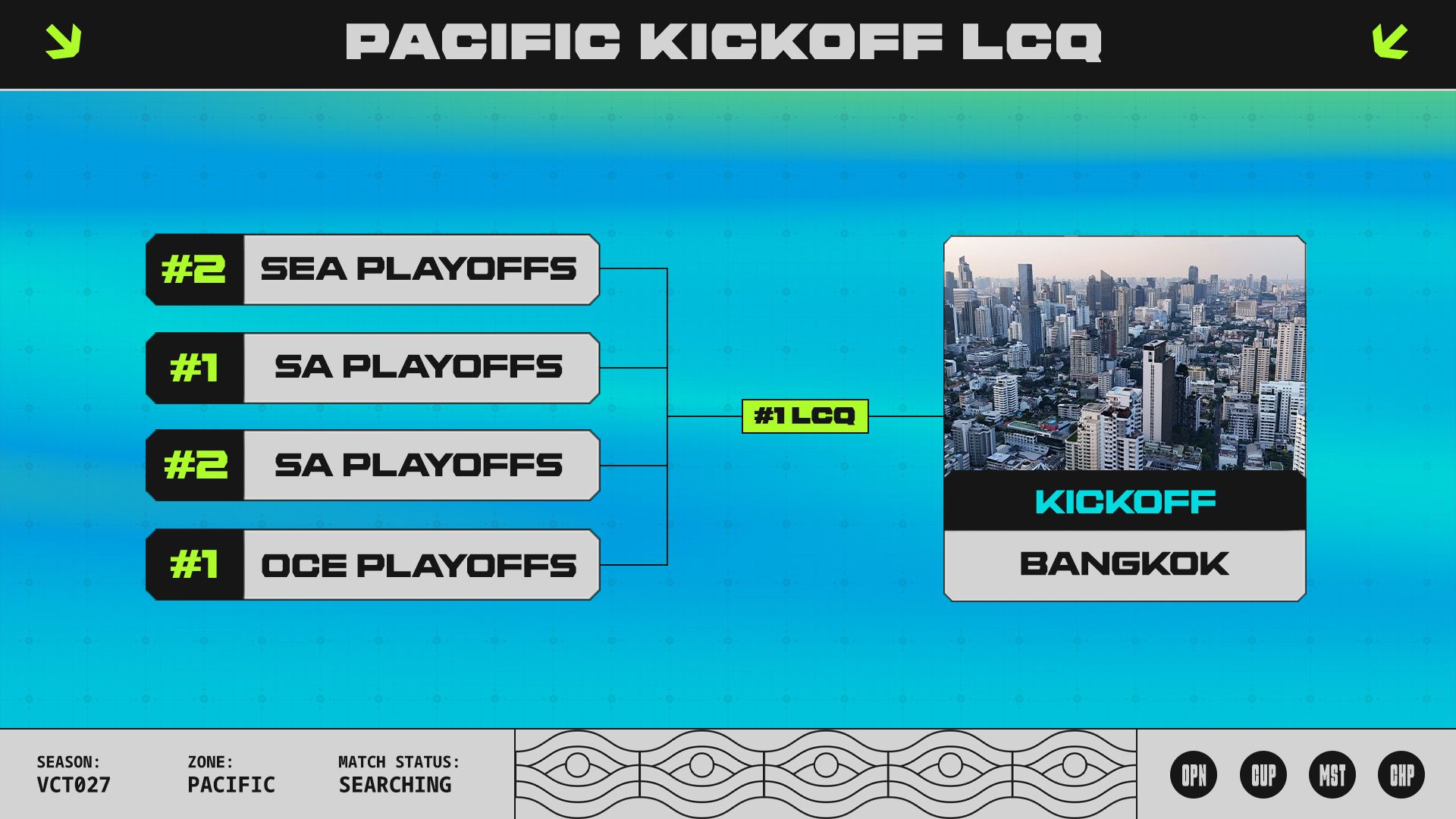
The Kickoff LCQ is a four-team contest. South Asia contributes its first- and second-place regional playoff finishers. Oceania contributes one team, and the Southeast Asia Kickoff playoff runner-up takes the last place. One winner goes to Bangkok. It is possible for both South Asian teams to lose; it is also possible for one to qualify. The format never guarantees that one South Asian side will be present at Kickoff.
A simple example helps. If two Indian organisations finish 1st and 2nd in the South Asian qualifying playoffs, both can enter the Kickoff LCQ. If an Indian side wins that LCQ, it reaches Bangkok and faces Pacific’s leading teams. If the winner is from Oceania or Southeast Asia, South Asia has no team at the main Kickoff event. Riot has not announced which organisations will fill those places.
Kickoff itself is not a world championship. Its top three finishers advance to Masters Seoul. Therefore, the full road for an Indian team is South Asian qualification, then the LCQ, then a strong finish at Kickoff. Every step is a separate sporting result, and none should be described as automatic.
Cup 1 and Cup 2 give South Asia another route, twice
The biggest structural shift comes after Kickoff. Riot is replacing the old Stage 1 and Stage 2 league tournaments with Cup 1 in Manila, April 29 to May 23, and Cup 2 in Tokyo, August 5 to August 29. These are separate qualification cycles, so South Asia can put forward 2 teams for each Cup LCQ based on the relevant regional playoffs.
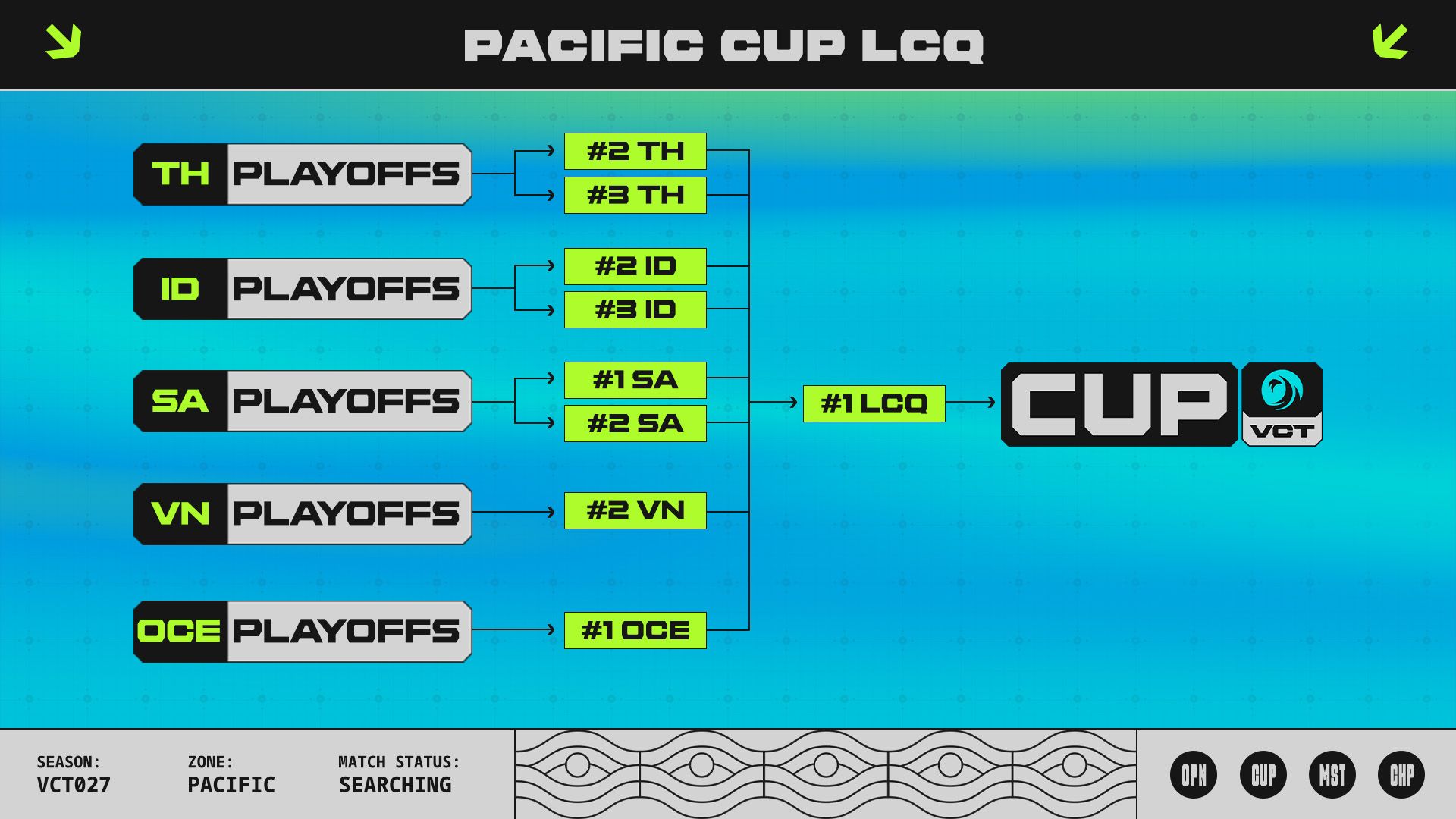
Each Cup has 12 places. Korea and Japan get 3 direct qualification places each; Southeast Asia gets 2; Thailand, Indonesia and Vietnam get 1 apiece. The last place is reserved for the Cup LCQ winner. South Asia and Oceania do not have direct Cup positions under this allocation.
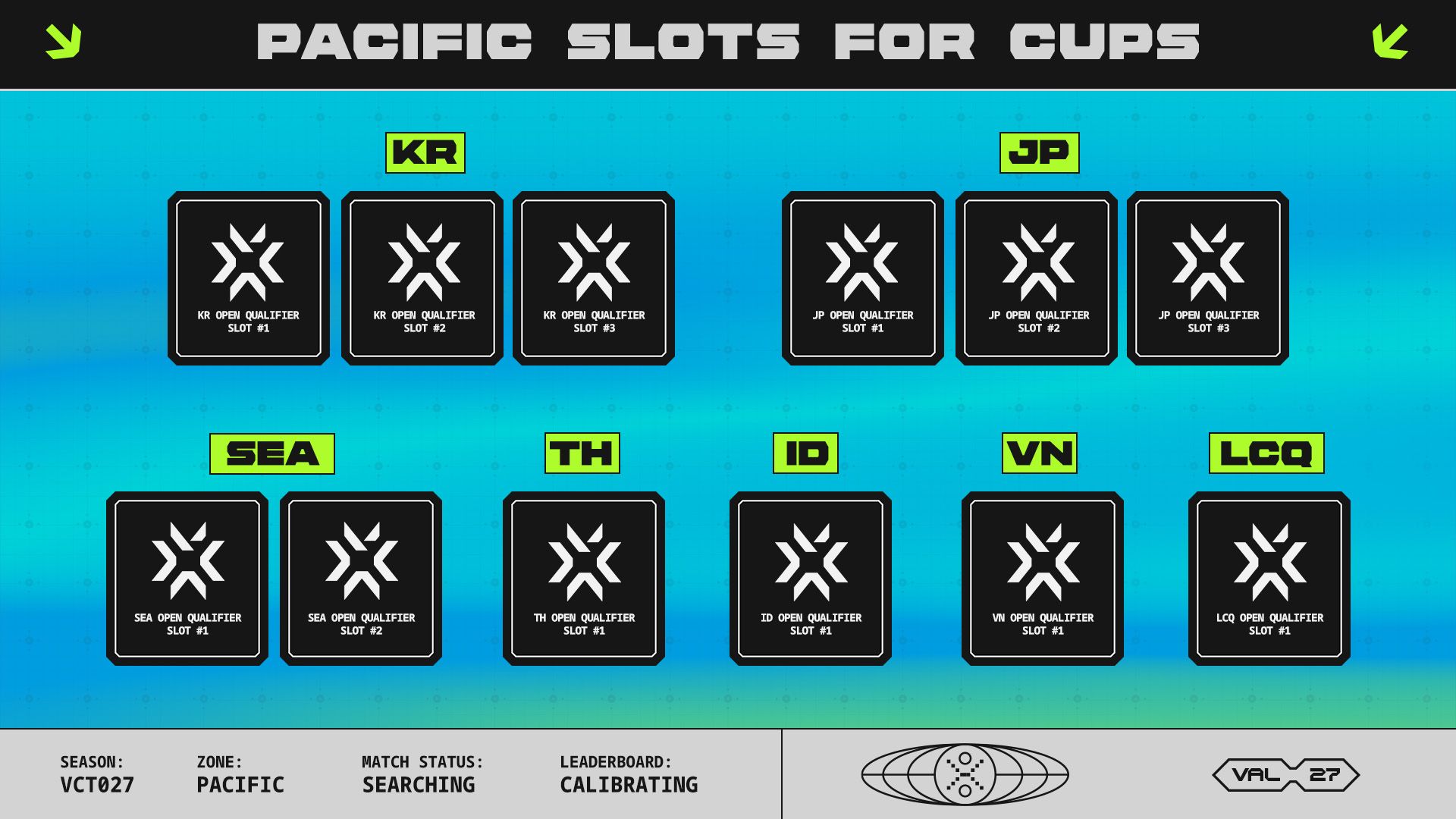
The Cup LCQ is harder to navigate than Kickoff’s. 8 teams compete: 2 from South Asia,2 from Thailand, 2 from Indonesia, Vietnam’s runner-up and 1 from Oceania. Once again, a single winner gets the main-event place. Two South Asian entrants do not mean two Pacific Cup finalists.
The difference from 2026 is still meaningful. A side that loses out in the first phase has a reason to keep practising and competing. Fresh results can earn a place in the following regional playoff, which can lead to Cup 1 or Cup 2. The exact South Asian qualification rules, seeding and eligibility will matter as well. Watch this space for next announcements.
Why this is progress for India, but not equal treatment with Japan or Korea
Some fans will reasonably ask why Japan and Korea each receive 3 direct Cup places while South Asia has none. Riot has allocated those places region by region, leaving South Asia and Oceania with an LCQ route. More teams can enter the race, but the number of guaranteed spots in the 12-team main events has not improved for South Asia.
That can be disappointing without making the announcement meaningless. A new Indian roster now has a clear sporting target beyond becoming the one regional champion. There is also room for two rival organisations to prepare for the same international qualifier. Better competition at home could develop deeper map pools, more experienced coaches and stronger players, even if the region still struggles at LCQs.
And there is an important detail in the wording: these are South Asian places, not places exclusively reserved for India. Eligible teams from the wider region can qualify. Indian organisations have to earn their positions in those playoffs rather than expect a national allocation.
What about T1, Paper Rex and the other Pacific partners?
Riot’s eight 2027 Pacific partners are T1, Gen.G, Paper Rex, Rex Regum Qeon, ZETA DIVISION, Crazy Raccoon, FULL SENSE and GAM Esports. None is an Indian organisation. Those partners get automatic places at Kickoff, while the four other Kickoff places are fought over through qualifiers. For the Cups, being a partner does not itself guarantee qualification; teams have to perform through the regional structure.
The headline for Indian players is therefore not “India gets a partnered league slot.” It does not. The opening is competitive: an eligible non-partnered team can reach the same major tournament by winning the appropriate qualifiers. The difference between those two ideas is important when deciding whether this is a genuine opportunity or a symbolic announcement.
The money: $75,000 in 2026, $100,000 for qualifying in 2027
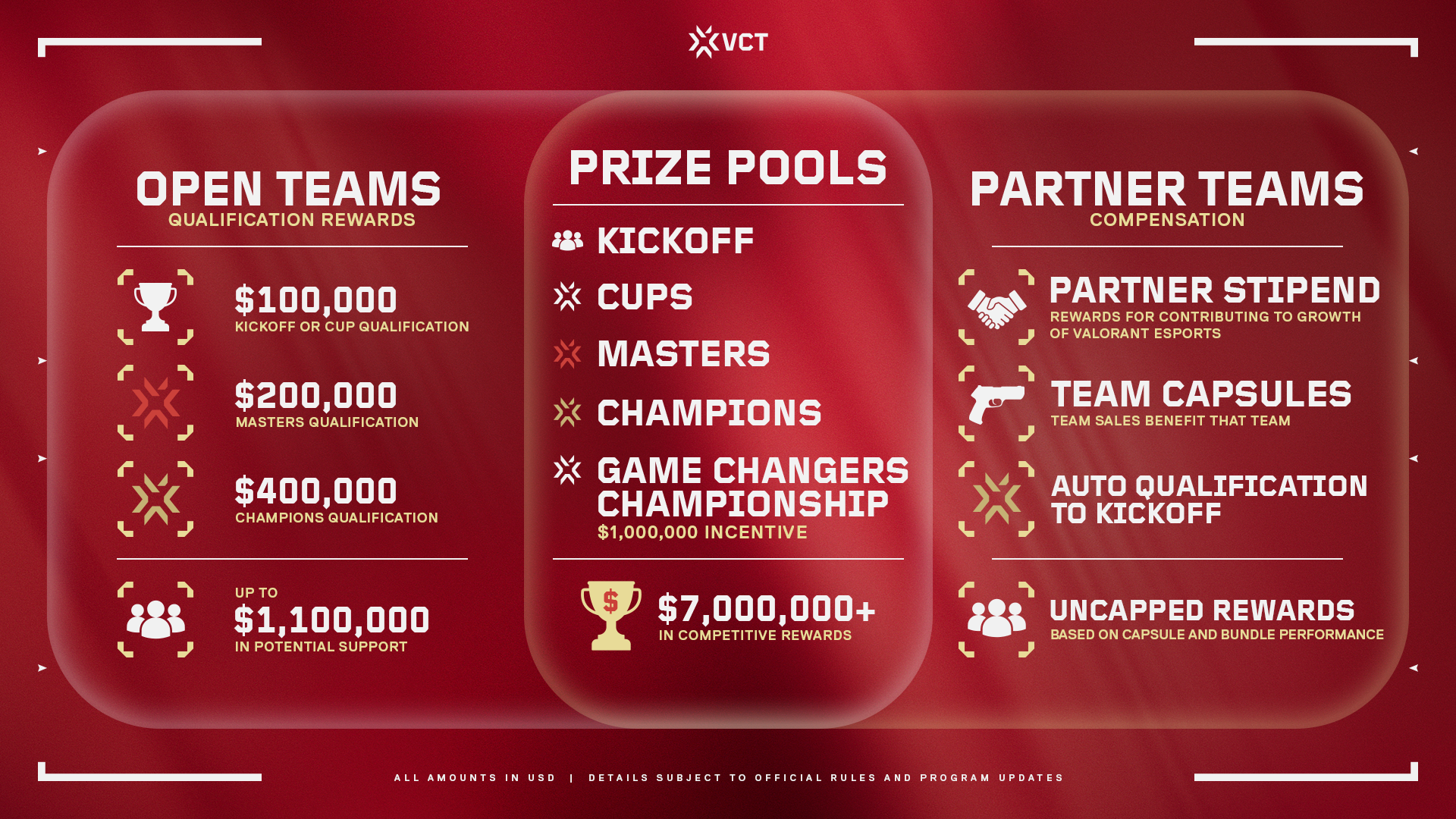
Riot’s earlier 2026 announcement said Challengers teams that reached the Pacific Stage 2 Playoffs would receive US$75,000. In the new circuit, an eligible open team that reaches Kickoff or one of the Cups will receive a fixed US$100,000 payment for that event, on top of any applicable prize money. Riot has separately outlined US$200,000 for eligible open teams reaching Masters and US$400,000 at Champions.
Those numbers matter for a South Asian organisation paying for player salaries, coaches, practice facilities, international travel and visas. But there is a crucial condition: South Asian playoffs and LCQs are qualifying steps, not the events that trigger the US$100,000 payment. A team must actually make the main Kickoff or Cup field.
Even a six-figure payment does not make the route easy or guarantee a profitable season. Teams still have to fund the months before qualification, follow Riot’s tournament rules, and remain competitive after reaching the main stage. A serious long-term programme is more valuable than building a roster around the hope of one cheque.
What an Indian VALORANT team should do next
Riot’s preparation guidance is practical. Players are expected to be Ascendant or above, pass Vanguard checks and meet tournament eligibility requirements. In most regions, at least three of the five players must belong to that region. Keeping three players together is also important for preserving a team’s competitive progress between stages.
There is also the work people rarely see on a highlight reel: passports, potential visa arrangements, a coach who can review opponents, consistent scrims and a reliable map pool. The LCQ will not be forgiving simply because South Asia now sends an extra representative. Teams have to survive against sides that may already have experience playing in stronger regional circuits.
The next public step is the South Asian Open Qualifier announcement. Riot has said the first qualifying period begins in November 2026, but local registration dates and full bracket rules had not been published as of October 28. Players should check Riot’s official VALORANT Esports channels and the regional organiser before registering.
The real test starts after South Asia sends two teams
It is tempting to celebrate two South Asian LCQ positions as two new VCT Pacific places. That would sell the announcement short and mislead readers. It is a broader qualifying route, not a guaranteed main-event allocation. The region now has more opportunities to show its level, but the best teams still need to beat opponents from Southeast Asia, Oceania and other Pacific circuits to reach the events that matter most.
S8UL’s dominant league run and No Salary Peek’s improbable final victory showed why South Asian VALORANT cannot be reduced to one team. The 2027 format finally reflects part of that competitive depth. Whether Indian teams can turn the extra places into appearances in Bangkok, Manila or Tokyo is the question that will decide how successful the change really is.
For now, the difference is clear: in 2026 South Asia had one name in one decisive LCQ. In 2027, it can send two names into several separate qualifiers. More chances are welcome. The wins still have to be earned.