
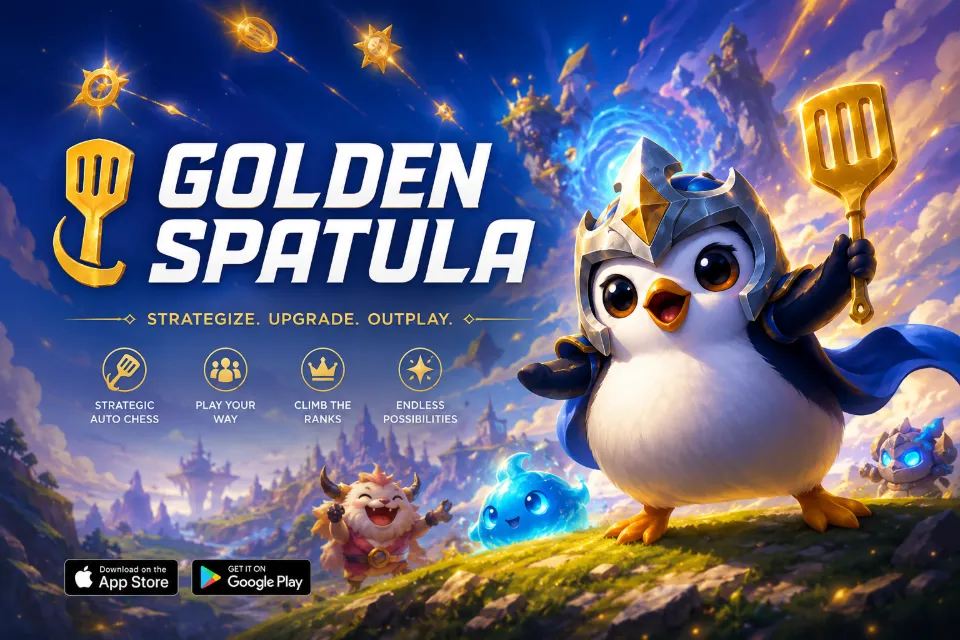
The global gaming press often treats mobile esports as a side story to PC tournaments, but Tencent's latest investment announcement challenges that hierarchy. The company has outlined a plan worth roughly one billion yuan to support Battle of the Golden Spatula, also referred to as Fight for the Golden Spatula, and its broader ecosystem. Depending on the exchange rate used, that is approximately $140 million to $150 million. The exact US-dollar conversion is less interesting than the commitment: this is a large, multi-year bet on the life of a mobile strategy game.
For readers unfamiliar with it, Golden Spatula belongs to the autobattler family, where the central skill is not reaction-speed aiming but building teams, managing an economy and choosing how to adapt when the shop or opponent's composition changes. It draws on a gameplay formula associated with Teamfight Tactics, but Tencent's Chinese mobile product has developed its own considerable audience and competitive presence.
What the investment is meant to build
Reporting on the announcement describes spending on competitive infrastructure, ecosystem development and the game's wider reach. Investment of this size can include tournament operations, broadcast production, player development, grassroots events and promotional programs. It should not be casually described as one giant prize pool handed directly to players.
That distinction matters because a successful esport needs more than a spectacular final. It needs a ladder through which unknown players can progress, organizers who can run events predictably, content creators who can explain the meta and a calendar that gives audiences reasons to return. A single major event can attract views. A sustainable circuit turns that attention into a community.
Why autobattlers attract a different kind of competitive audience
Autobattlers reward forecasting, adaptation and resource management. Players must decide when to spend, when to save, which units fit a composition and how to react to other boards. Those decisions translate into broadcast drama, but not always into immediately obvious visual moments. Commentators have to explain a slow strategic decision so that its payoff makes sense when it arrives several rounds later.
The challenge is particularly important on mobile, where the game has to remain accessible on smaller screens. Viewers need readable compositions, clear player standings and explanations of why a seemingly strange item choice creates an advantage. A bigger production budget helps only if those presentation problems are solved.
The announced plan is bigger than a single prize pool
Tencent's commitment is stated as one billion yuan over three years, with spending intended to support development, creators, community activity and esports. The annual championship is one part of that package, not another description of the whole fund. Reporting the amount as $150 million is a rounded currency conversion; the yuan figure and the time horizon are the more precise facts.
The publisher's plan calls for three annual national open tournaments plus a new championship, with a 10-million-yuan competition ecosystem prize pool and an aim to double total esports prize money in 2027. Campus competition is another strand: its Prism Academy initiative aims to expand offline events from roughly 100 to 300. Those details show how the company is trying to create both top-level spectacle and a broader path for players to enter competition.
Tencent also described more than 240 million registered accounts and over 50 million monthly active users, two measures with very different meanings. Registration is cumulative; active users indicate the nearer-term scale of an audience. A dedicated PC edition is planned with cross-platform account, matchmaking and social connections. None of this guarantees that the Chinese circuit will immediately become a global one, but it makes dismissing the market as a niche mobile spinoff increasingly difficult.
The Chinese market is not a small regional footnote
Mobile gaming in China operates at a scale that can make Western PC-only assumptions seem inadequate. A game can have an enormous domestic audience and still be comparatively unfamiliar to readers in India, Europe or North America. That gap does not reduce the significance of the audience it has built. It simply shows how regional ecosystems can develop on very different foundations.
Tencent's plans can also influence the broader competitive strategy genre. If Golden Spatula demonstrates that large-scale mobile autobattler tournaments can operate predictably, other developers may put more emphasis on spectator tools, ranked integrity and tournament-friendly modes from the beginning of development.
What remains uncertain
The announcement does not mean Golden Spatula will automatically become a global competitor in every region. Distribution, local publishing, tournament permissions, language support and cultural familiarity all affect expansion. A domestic esports strategy cannot be assumed to translate unchanged into India or another market.
We should also avoid treating announced investment as money already spent. A multi-year commitment is a plan that will need to be evaluated against execution. Tournament participation, player retention, publisher reports and the quality of broadcast coverage will reveal whether the funding produces lasting growth.
Registered users are not the same as current players
Coverage of Golden Spatula's expansion cites a huge registered audience, reported at more than 240 million accounts. That number illustrates reach, but registration is not a daily active-user count. People may create accounts and never return, play irregularly or use multiple accounts over time. Esports planning requires more granular information: how many users watch competitive events, how many participate in ranked play, how often they come back and which formats can retain them between major tournaments.
A project that spends heavily on a final while ignoring those habits can produce a one-night spectacle and little else. Tencent has the opportunity to build a pipeline in which casual players find strategy content, competitive hopefuls progress through events and spectators can understand high-level play. That is the difficult work implied by the investment headline.
The bigger signal
Tencent is emphasizing an ecosystem rather than simply marketing a download. That is the interesting part. It suggests the company sees competition, creators, spectators and ordinary players as connected pieces of the product. The important future question is not whether one mobile game can produce a flashy headline; it is whether this investment helps build a scene with enough depth to survive after the initial publicity fades.