
India has no shortage of gamers. It has a shortage of games that the world recognises as Indian-made. That difference will be impossible to ignore when the India Game Developer Conference returns to Chennai on October 28. At one end of the industry is Ludo King, a homegrown download giant. At the other are ambitious PC, console and mobile projects that may spend years searching for their first serious audience. Between them sit hundreds of developers asking a deceptively simple question: how do we turn making a game into making a living?

For four days, game makers, artists, publishers, investors and players will be in the same building. They will see polished trailers, unfinished prototypes, failed experiments and, perhaps, the next idea worth funding. The previous version of this story asked when India would produce its next global hit. The answer is more complicated, and more exciting: India has already produced very large games. What it has not yet done consistently is turn those successes into a recognisable pipeline of original, sustainable franchises across genres and devices.
IGDC 2026 is designed for precisely that awkward middle ground. Organisers project more than 10,000 visitors across four days and say 60 independent studios and developers will be showcased. The industry conference runs October 28–29, followed by the public-facing Playground on October 30–31.

IGDC 2026: the confirmed event basics
- Event
- India Game Developer Conference 2026 (18th edition)
- Venue
- Chennai Trade Centre, Chennai
- Dates
- October 28–31, 2026
- October 28–29
- Business conference for developers, publishers and industry professionals
- October 30–31
- IGDC Playground, the public-facing gaming and careers programme
- Expected attendance
- 10,000+ (organiser projection, not an audited turnout)
- Indie spotlight
- 60 studios/developers (announced)
- Organiser
- Game Developer Association of India (GDAI)
- Official website
- https://indiagdc.com/
This is what the 2025 expo looked like. There were not just big-company stalls; small teams were putting playable games in front of strangers. Last year's conference is a useful benchmark precisely because it gives us a picture of what the 2026 promises are supposed to become. The official IGDC highlight post reported over 4,200 attendees, 170 speakers and 2,500 curated meetings through Investor–Publisher Connect.
An enormous audience is not the same as an export industry
Lumikai's 2025 industry estimate places India's gaming audience at approximately 555 million. That number needs its methodology attached, not treated as a headcount from a universal census. It does tell us the domestic audience is enormous. But market size alone cannot tell us whether Indian studios own the underlying games, develop for overseas players, or retain enough revenue to finance a second title. Lumikai's research is most useful when read alongside those missing questions.
Think about the games at the centre of Indian gaming conversation: some are global franchises with local servers, tournaments and communities; others are successful games adapted to Indian tastes. They may employ local people and generate serious commercial activity, but their underlying intellectual property does not automatically belong to Indian studios. A strong player market can coexist with a weaker pipeline of locally owned franchises. Treating them as the same thing is how the industry ends up celebrating downloads while its own developers struggle to finance a second project.
There is another uncomfortable reality. PC and console games may be the titles that attract critical acclaim, but India’s gaming habits and spending are far more mobile-heavy. An original premium title can win awards and still find it difficult to reach a large domestic paying audience. That means success may involve finding buyers outside India first. The mission is not to make every Indian developer produce an expensive blockbuster. It is to make a range of sustainable studios possible, from tiny narrative-game teams to creators of international mobile hits.

India already has viral hits. Not all of them look like a blockbuster
Consider the scale of Ludo King Sensor Tower's India mobile-gaming report counted more than 1.25 billion lifetime downloads by June 2025. It has been a constant on Indian download charts for years, with a premise anyone can understand in ten seconds. It is an extraordinary Indian gaming achievement, although cumulative downloads are not the same thing as unique active players or paying customers. Sensor Tower's report is specific about that distinction.
Then there is Indian Bikes Driving 3D. Rohit Gaming Studio's chaotic, accessible mobile driving sandbox became a playground for YouTubers, cheat-code clips and improbable stunts. Third-party app data puts it in the hundreds of millions of downloads; Sensor Tower's listingplaces it in the 100–500 million install band. That success says something the industry occasionally forgets: polish is not the only route to virality. A simple game with infinite shareable situations can spread faster than a premium trailer.
And the world outside these huge mobile figures matters too. Pune-based Nodding Heads Games said Raji: An Ancient Epic had reached two million players by its fourth anniversary. That is a different metric, on a different scale, but it demonstrates Indian mythology can travel as a complete game rather than just as an attractive art direction. For a country whose game market is dominated by phones, those PC and console pathways remain worth defending.
Four different forms of Indian gaming success
| Game | Evidence of traction | What it proves |
|---|---|---|
| Ludo King | 1.25 billion+ cumulative downloads by June 2025 (Sensor Tower estimate) | Indian social games can achieve enormous long-term mobile reach |
| Indian Bikes Driving 3D | 100–500 million installs band (Sensor Tower) | Creator-friendly chaos can drive organic game discovery |
| Raji: An Ancient Epic | 2 million players announced by its developer in 2024 | Indian-designed premium stories can reach global audiences |
| The Palace on the Hill / Detective Dotson | Released Indian-made PC titles with distinctive settings | Not every worthwhile Indian game needs to imitate a shooter |

The uncomfortable cases: hype, delays and a second life
For every screenshot that wins social media, there is a release that struggles to keep players. The original FAU-G arrived on Republic Day in 2021 with enormous expectations. Early reviewers criticised its narrow gameplay, limited features and controls. Its Google Play rating fell sharply within days, The Quint reported. Later attempts to build out the FAU-G franchise do not change the original lesson: curiosity can secure the first download, but it cannot guarantee the second session.
Indus is a different story and should not be filed away as a dead game. SuperGaming continues to list Indus Battle Royale as live. But an April 2026 investigation by Outlook Respawn found that the promised ₹2.5 crore Indus international esports finale remained indefinitely postponed. The studio also carried its battle-royale technology into Prime Rush for Brazil. A game continuing to exist, a tournament failing to materialise and a team expanding to a new market can all be true at once. For players who trained for that LAN, the delay was not a footnote.
Likewise, Mumbai Gullies has been an attention-grabbing promise of an open-world Mumbai, but its Steam release still reads "Coming soon" even though Nikhil Malankar, the founder of the company has confirmed (in early April 2026) that the development of the game has been stopped indefinitely and Mumbai Gullies is considered cancelled due to financial struggles. It is reported that the founder personally invested over ₹2.36 crores after the studio ran out of money and external investor backing fell short or failed to keep up with costs.
Not every setback is a shutdown
| Project | What is verifiable | Editorial takeaway |
|---|---|---|
| Original FAU-G (2021) | Major launch attention followed by documented critical and player complaints | National attention does not replace mechanics and retention |
| Indus esports circuit | Publicly announced ₹2.5 crore plan; LAN finale remained on hold as of April 2026 | Community promises need operational follow-through |
| Mumbai Gullies | Steam listing still says Coming soon | Follow development, but do not turn an unreleased game into a launch headline |
Sixty studios. The important part happens after the showcase
The conference’s indie initiative is the headline opportunity. Organisers say 60 independent developers and studios will be showcased, while its Investor–Publisher Connect programme is designed to place selected teams in front of decision-makers. Reporting ahead of the event says 32 participating investor and publisher organisations had been lined up as of October 22. They include names such as Devolver Digital, Headup, Miniclip and Voodoo, alongside Indian companies and investment firms. Those names illustrate the breadth of the room, not promises that any particular game will receive funding.

IGDC's Investor–Publisher Connect offers curated studio meetings, fast-pitch sessions and mentorship. Its programme page puts the 2026 application deadline at October 10, so it is not a walk-up funding counter for someone arriving on October 29. The announced group of 32 participating organisations includes publishers such as Devolver Digital, Voodoo, Headup and Miniclip, and investors including Makers Fund, Lumikai and Elevation. Those are names on the programme, not announced investments in the 60 showcased games.
Four different opportunities, four different outcomes
| 2026 programme | Who it is for | What it can actually deliver |
|---|---|---|
| Indie 60 showcase | Original-game developers | Hands-on exposure and publisher conversations; no funding guarantee |
| Investor–Publisher Connect | Shortlisted studios | Curated meetings, five-minute pitches and mentor feedback |
| India Game Awards | Studios and creative teams | Recognition and discoverability, not proof of commercial success |
| IGDC Playground | Players, students, families | Playable games, community sessions and career discovery |
It would be easy to label this a turning point simply because international publishers are attending. A more useful follow-up is to track signed publishing arrangements, announced funding, game launches and player retention six or twelve months later. The conference is a doorway. There is still a product to finish on the other side.
What actually happened at IGDC 2025? Look beyond the stage photos
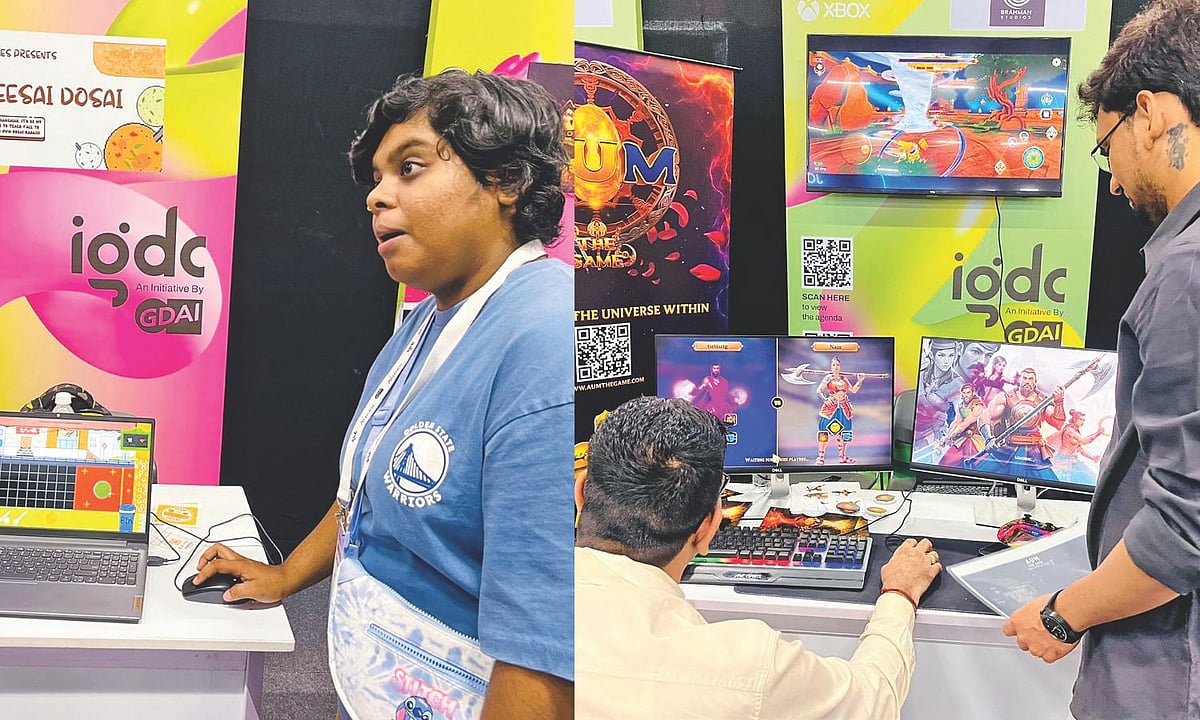
A strong memory from last year is not a celebrity on stage. It is a cooking game about dosas. At the Chennai expo, Thumbi Games showed Meesai Dosai, a Tamil-flavoured cooking simulator, beside projects such as Brahman Studios' mythology-based AUM. DT Next's on-floor reporting showed how much more interesting original Indian game design becomes when it stops trying to look internationally anonymous. A playable dosa stall is as legitimate a creative export as a fantasy sword.
The 2025 India Game Awards also give a better snapshot than a generic "Indian gaming is growing" slogan. 1000 Deaths from Pariah Interactive won PC/Console Game of the Year and Best Art Direction; Liminal Exit from Little Red Dread won Indie Game of the Year; Idle Networks from Faelight Games won Mobile Game of the Year; and Frontier Paladin was recognised as the Upcoming PC/Console Game of the Year. These names are a reminder that the developer scene is far wider than the handful of projects gaming Twitter can recognise.

Last year also produced announcements with a longer shelf life than a press quote. Tamil Nadu signed memoranda of understanding involving Nazara Technologies, Lakshya Digital and Reliance Games, according to the 2026 event briefing. This is exactly the sort of claim a serious newsroom should revisit: an MoU is not a completed studio, a job created or a shipped game. Where did the commitments go after the photographs?
Indian games already have an identity of their own
Consider The Palace on the Hill Niku Games built an adventure around village life and the textures of 1990s India, not around a reskinned version of a foreign multiplayer hit. The game took the PC/console and indie honours at the 2024 IGDC Awards. It is a small but useful case study: an Indian setting can be the substance of a game rather than a marketing decoration. The 2024 winners list documents those awards.

Then there is Detective Dotson, which launched on Steam in April 2025. Ahmedabad-based Masala Games put an aspiring Bollywood actor in a detective story filled with street food, bargaining, disguises and neighbourhood characters. The point is not that every studio must build a game about India. It is that local experience can create mechanics and humour that players elsewhere have not seen in exactly the same form. Dotson became a shipped product, which is a harder milestone than a polished trailer.

The broader development scene is not limited to heritage, mythology or cosy adventures either. India has teams making horror games, puzzle games, strategy projects, arcade titles and commercially focused mobile experiences. That range is healthy. A studio should be allowed to make a frightening global horror hit without adding an obligatory historical monument to prove where its founders come from.
The next wave: cricket, open worlds and stories nobody else can tell
LightFury Games' eCricket is an obvious one to follow, because it is trying to play in a genre India already understands better than almost anywhere. First shown at GDC in San Francisco in March 2025, the Unreal Engine 5 project has a stronger commercial story than an ordinary teaser. Winners Alliance said in January 2026 that the game had secured more than 600 licensed international cricketers; the studio later advertised more than 700 in its Ultimate Squad mode. It also raised $11 million in April 2026 with players including MS Dhoni and Jasprit Bumrah among strategic investors. Rohit Sharma later has joined the action too.
In August, Rohit Sharma joined as an investor and licensed player, while the studio said more than 300,000 people had signed up and it was preparing phased closed-beta access. That is a sign of attention, not proof of a smooth launch. The test is whether batting feels convincing, netcode holds up and the game earns a place beside established cricket titles after the celebrities finish posting. On the day of writing, Lightfury has confirmed that the closed-beta is now live for exclusive testing.

On PC and console, the menu is just as varied. Mukti from Mumbai-based underDOGS Studio is an upcoming first-person narrative game set in an Indian museum, supported through Sony's India Hero Project; it is still listed as coming soon. The Age of Bhaarat wants to turn Indian epic fantasy into a high-end action adventure.
Indian games worth following, not announced IGDC 2026 launches
| Game | Developer / origin | What to watch |
|---|---|---|
| LightFury eCricket | LightFury Games, Bengaluru | Licensed cricketers, cricket physics, online reliability and beta-to-release transition |
| Mukti | underDOGS Studio, Mumbai | Story execution, PlayStation and PC launch, accessibility |
| Mumbai Gullies | GameEon Studios, Mumbai | Actual playable scope and release timing |
| The Age of Bhaarat | Tara Gaming | Combat quality and whether Indian mythology becomes compelling gameplay |
| Meesai Dosai | Thumbi Games, Chennai | How a local cultural idea connects with a much wider audience |
The hardest boss fight is getting people to discover your game
For a sense of the personality Indian studios can bring to the screen, watch Masala Games’ own Detective Dotson trailer. It predates IGDC 2026 and is presented here as an example of original Indian game-making, not as a new conference announcement.
Chennai is part of a global circuit, not an isolated celebration
A developer going to Chennai should think about what happens next. San Francisco's Game Developers Conference is built around the craft and business of building games. Gamescom in Cologne mixes trade access with the pressure of an enormous consumer show. Tokyo Game Show combines business meetings and public play on a similarly international stage. LightFury choosing GDC 2025 for its eCricket debut makes this comparison tangible: Indian studios can aim for the same room in which major publishers and specialist media look for what comes next.

IGDC cannot match those events in global reach yet, and does not have to. Its unusual advantage is proximity: an Indian student can travel to Chennai more readily than to San Francisco; an early-stage studio can meet Indian colleagues who have already solved local payments, hiring, publisher contracting or discoverability problems. The next step is moving those teams from a local demo to a global wishlist, a publisher pitch or a playable showcase abroad. That international circuit is a route, not a guarantee.
How IGDC fits beside major international game events
| Event | 2026 location | Why an Indian studio might care |
|---|---|---|
| India Game Developer Conference | Chennai, India, Oct 28–31 | Domestic networking, Indie 60, IP Connect and community play |
| GDC Festival of Gaming | San Francisco, United States, Mar 9–13 | Deep production sessions and publishing contacts |
| Gamescom | Cologne, Germany, Aug 26–30 | Global public exposure, distributor and press conversations |
| Tokyo Game Show | Chiba, Japan, Sep 17–21 | Asian and global publishing connections, demos and consumer feedback |
Making a strong game is expensive. Making sure anyone hears about it can be just as difficult. A tiny studio competes against major releases, discounted back catalogues, algorithm-driven storefronts and endless creator feeds. A positive conference demo may not translate into wishlists. Wishlists may not translate into sales. Sales may not produce enough revenue to keep the original team together. None of these steps can be solved with a larger opening ceremony.
The people in the room matter because discoverability is rarely solved by a single trailer. One conversation can help a studio fix a weak Steam page, understand console certification, improve a pitch, localise a game, build a community or find a publisher that genuinely fits the project. In IGDC's announced 2026 mix are industry figures and specialists linked with studios including Blizzard, Remedy, Playtika and global publishing firms. A young Indian team does not need every contact. It needs a few useful ones, and a playable game that makes people remember the meeting.
The GDAI has also published a long-term Vision 2035 built around 5,000 original-IP studios and 100 globally significant companies with more than $100 million in scale.
This year, the doors open to players too
For people who do not work in games, the biggest improvement may be the last two days. IGDC Playground opens on October 30 and 31 with advertised esports zones for BGMI, VALORANT and Honor of Kings, console and VR experiences, Pokémon, anime, cosplay and board games. A separate career track offers concept-art and game-design workshops, expert conversations and an introduction to jobs across art, programming and production. This is a public programme, but tickets, access conditions and individual session timings should be checked on the official site.
That public access has a second purpose beyond footfall. A teenager who turns up for a match might watch someone demo a game they built in Chennai. A parent who sees a playable project may better understand what “working in games” actually means. And a developer can learn in five minutes of watching strangers play something that would take weeks of internal testing to uncover. Meeting the audience before launch is not a PR benefit. It is part of making a better game.
Should you actually attend IGDC 2026? Here is who gets the most out of it
If you are a player or creator October 30–31 is the obvious entry point. Try games you have never heard of, ask the people at the booths how they made them and film the parts that are genuinely fun. A creator with a small audience may be more helpful to a local developer than a huge page sharing a generic sponsor graphic. The official Playground describes daily esports activity, console and VR, anime, cosplay and Pokémon programming, but does not promise that every specific game mentioned in this article will have a playable demo.
If you are a student or parent : the career track is the point. Ask what a junior game artist actually shows in a portfolio, how game designers get their first production credit and whether a course teaches industry tools or just sells a dream. Speak to a studio about internships and entry roles. Bring a portfolio link, a small build, or a concise set of questions; an expensive degree alone is not a hiring strategy.
If you are a developer come with a two-minute playable pitch, a working build, your actual production budget, and a clear answer to who the game is for. IGDC's IP Connect application deadline is already past, so check whether other expo or networking formats remain open. Publishers can help with production and marketing, but every deal has trade-offs over funding, IP rights, milestones and revenue share. It is reasonable to walk away from a proposal that you cannot explain.
If you are a studio founder, investor or recruiter the value is less glamorous. Ask for the burn rate, build milestones, team turnover, player retention and the plan for the next 12 months. Meet teams whose games did not work as well as the winners. A serious ecosystem needs honest postmortems just as much as award nights.
Your IGDC 2026 visit: what to prioritise
| Visitor | Best dates | One practical goal |
|---|---|---|
| Gaming fan / creator | Oct 30–31 | Play and share one original Indian game with proper developer credit |
| Student / aspiring developer | Oct 30–31 career track | Collect portfolio feedback and learn one concrete entry path |
| Indie studio / game professional | Oct 28–29 | Get useful production feedback or a qualified business introduction |
| Investor / publisher / recruiter | Oct 28–29 | Meet teams with real builds and credible delivery plans |
IGDC 2026 Chennai: date-by-date guide
| Date | Programme | Who should focus on it |
|---|---|---|
| October 28, Wednesday | B2B conference, expo and sessions begin | Studios, professionals, investors, students with relevant passes |
| October 29, Thursday | Business conference and industry networking continue | Developers seeking publishing, hiring and production knowledge |
| October 30, Friday | IGDC Playground opens | Players, creators, students, families, gaming fans |
| October 31, Saturday | Second public Playground day | Hands-on visitors and future game makers |
What India should measure after October 31
First, how many of the 60 showcased developers turn conference conversations into working partnerships? A meeting should not be counted as an investment. Second, how many studios can keep control of the games and worlds they create while securing the support required to finish them? Funding on poor terms can be as damaging as no funding. Third, how many players discover and genuinely enjoy a new Indian game rather than simply applauding its nationality? Those are different questions, and all three matter.
There is also a story to be told about ownership. India already contributes talent and services to the global games business. That is valuable work. But building a lasting domestic creative industry also requires teams that own their characters, technology, brands and sequels. Otherwise, the country can be indispensable to the process while remaining absent from the credits that audiences remember.
The scorecard that matters after the lights go down
A strong follow-up in November should be able to name which indie games were playable, which teams found publishing interest, whether any new game was actually launched and what concrete commitments emerged from the showcases. The organiser can also publish figures that are easier to audit than a footfall forecast: shortlisted pitches, signed deals where studios agree to disclose them, verified career placements and projects that secure international showcases. Until then, the 10,000-plus figure is an expectation, not evidence of what the event delivered.
The harder, longer-term question is whether Indian games can stay Indian-owned while becoming global. Licensing, quality assurance, marketing, translation, user acquisition and console compliance rarely make the hype video, but they determine whether a studio reaches game two. The goal is not to turn every indie idea into Ludo King. It is to give the next Raji, the next breakthrough mobile sandbox and the next quiet regional-language story enough room to exist.
The opportunity in Chennai is real, and so is the risk of overselling it. Nobody needs to call IGDC 2026 the moment India finally arrived. The Palace on the Hill, Detective Dotson and many quieter releases have already shown that Indian creators can ship original work. The next challenge is making sure they are not one-game stories. If Chennai helps even a few promising teams find an audience, finish their next title and stay in business, that will be a more meaningful headline than the attendance counter.
For official timings, programme changes and passes, use IGDC’s website. For the public gaming and career programme, see IGDC Playground Organisers have announced activities and an expected turnout, but any eventual attendance, deals or award results will require post-event verification.