
Roblox says more than 70,000 games have been published using its AI-assisted Build tool. The figure is in the company's third-quarter 2026 earnings materials, not a creator's viral estimate. More than 500,000 people have tried Build since its alpha began in selected countries. For a platform where publishing used to require a fair amount of patience with development tools, that is a substantial change in who can attempt to make a playable experience.
It is also a very easy number to misuse. Seventy thousand published games does not mean 70,000 hits, 70,000 original ideas or 70,000 sustainable businesses. Publishing is the entry point. Getting someone to click, teaching them how to play, keeping a game safe and giving them a reason to come back are different problems. Roblox is unusually direct about that distinction in its investor materials: as content creation becomes easier, discovery, audience aggregation, monetisation and safety become more valuable.
What did Roblox actually announce?
The company's earnings material says Build, its prompt-to-game creation tool, has been tested in New Zealand, Singapore, Serbia and Thailand. More than half a million users have tried it, and together they have published over 70,000 games. Roblox also says more than 80% of its top 100 experiences by hours engaged used AI tools to accelerate creation in the preceding month. That is a measure of tool adoption, not a statement that AI authored 80% of every line or asset inside those games.
The company also reported that the volume of daily asset uploads to its cloud tripled month over month. Among leading creators, time spent using AI tools rose, and usage of its model context protocol integration grew. The message is clear: AI is moving from a novelty button into the daily workflow of people who already know how to ship games. The popular image of somebody typing one sentence and obtaining an entire successful game is much less representative than this mixture of acceleration, editing and human decision-making.
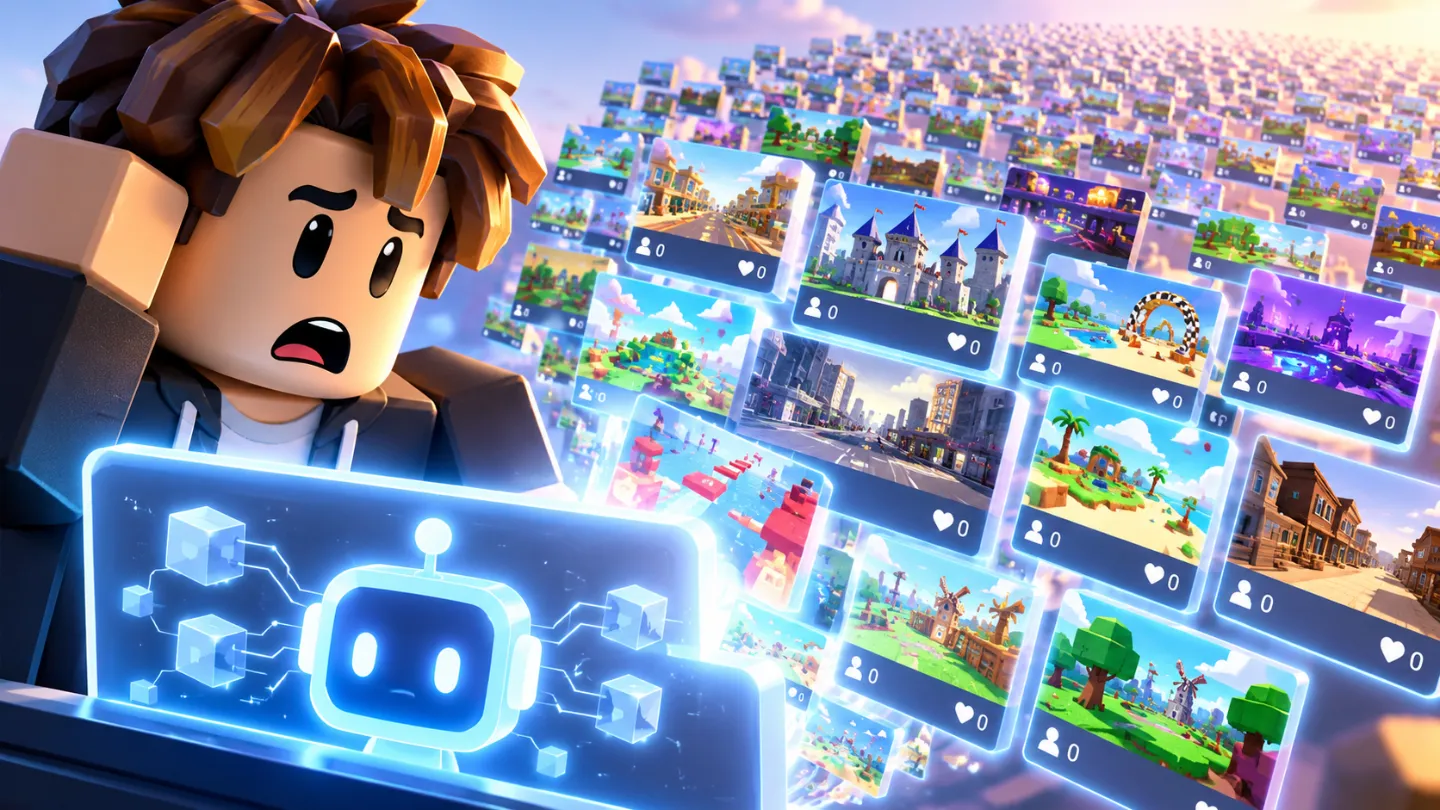
The discovery problem becomes harder when publishing gets easier
Players have only so many hours. If a platform doubles or triples the amount of new content without improving the ways people find good experiences, the average new creator can become less visible even while the total number of published games grows. That is a mathematical problem before it is a philosophical argument about AI. Thousands of new choices compete for essentially the same attention.

Recommendation systems reward signals such as satisfaction and time spent, but developers must also design good introductions, clear goals and games that actually work. A half-finished generated world may be technically publishable without being enjoyable. It can crowd a catalogue and make discovery harder for independent builders who spent months refining one project. The opposite is also possible: a person who never learned formal coding may use Build to prototype a distinctive idea and then improve it with feedback. The numbers do not decide which future wins.
Who owns the work, and who checks it?
AI-assisted production raises familiar questions about originality, asset sources and moderation. Roblox's announcement is evidence that people are making experiences faster, not evidence that every generated character, script or environment is safe to publish. Where user-generated content is involved, bad actors can also move faster. Platforms must check for prohibited content, rights issues, impersonation and unsafe social features at the scale of creation they are encouraging.
For creators thinking about monetisation, a game being published is also not equivalent to revenue. Earnings depend on player engagement, platform rules, age-related restrictions and whether the experience qualifies for the applicable payout systems. New users should read creator terms and moderation policies rather than rely on promotional videos claiming 'instant money from AI'.
Roblox's long-term vision extends beyond Build. Its investor filing describes an initiative called the Universal Player, aimed at bringing more types of games into the Roblox ecosystem. That ambition implies the company wants to become a distribution platform for experiences traditionally associated with other devices, not merely a destination for simple user-built games. It also suggests how strongly Roblox sees control over discovery as a future business advantage.
The 70,000 figure deserves coverage because it shows how quickly the tools are being adopted. It does not prove that human game design is obsolete. If anything, it makes the hardest human skills more visible: deciding what is worth building, noticing what players do not understand and making a world that holds together after the prompt has finished running.
